
FASSTTECH

About Us

Achievements of Infrared Thermal Imaging Technology in the Industrial Sector

Views : 4
Update time : 2026-07-21 17:15:00

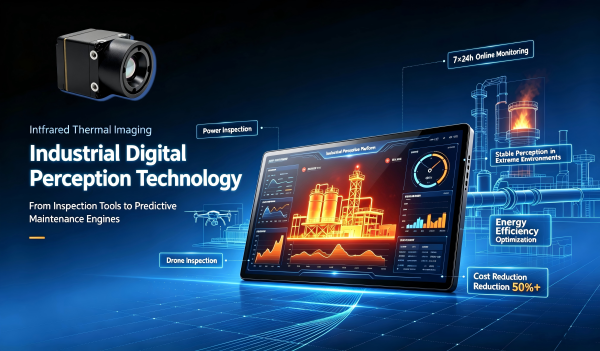
After years of industrial rollout, infrared thermal imaging has evolved from a standalone inspection tool into a core sensing technology for industrial digitalization, delivering multi-dimensional value to the industry.

1. Complete overhaul of O&M models: from reactive repair to predictive maintenance
Infrared thermal imaging has driven a generational upgrade in the operation and maintenance of industrial equipment.
It replaces the traditional passive model of scheduled inspection and post-failure repair, enabling 24/7 online monitoring and proactive early warning of hidden hazards.

2. Breaking the limits of extreme-environment monitoring and filling industry technical gaps


Infrared thermal imaging has resolved a wide range of long-standing industrial challenges where measurements were previously impossible, inaccurate, or unsafe to perform:

*Temperature coverage: It enables precise non-contact measurement across the full temperature spectrum, from low-temperature LNG applications at -40°C to high-temperature kilns operating above 1500°C.  

*Environmental adaptability: It operates reliably in harsh conditions including strong electromagnetic fields, high dust concentrations, flammable and explosive atmospheres, and highly corrosive environments.

*Personnel safety: Unmanned monitoring in high-risk zones greatly reduces the risk of casualties and significantly elevates the level of intrinsic safety.


3. Empowering digital process upgrading and directly improving product quality


Infrared thermal imaging has expanded beyond an O&M tool to become integrated into production process control.
It has transformed numerous process steps that relied on worker experience into> It has markedly reduced product performance variation, substantially lifted the yield and consistency of high-end manufacturing including premium steel and lithium battery materials, and directly supports the industry’s upgrading toward high-end production.

4. Dual benefits of energy efficiency and safety with remarkable cost reduction outcomes


*Safety value: It delivers early warnings of major accidents such as fires, medium leakage and equipment burn-through, cutting the rate of major equipment accidents in high-risk sectors like petrochemicals and metallurgy by over 40%.
*Energy efficiency value: It accurately identifies energy leakage in pipelines, kilns and storage tanks, reducing the overall energy consumption of industrial systems by 5%–15%. Annual cost savings for a single large plant can reach millions of yuan.

相关新闻
Achievements of Infrared Thermal Imaging Technology in the Industrial Sector Achievements of Infrared Thermal Imaging Technology in the Industrial Sector

Jul 21,2026
1. Complete overhaul of O&M models: from reactive repair to predictive maintenance. 2. Breaking the limits of extreme-environment monitoring and filling industry technical gaps. 3. Empowering digital process upgrading and directly improving product quality. 4. Dual benefits of energy efficiency and safety with remarkable cost reduction outcomes.
The Scramble for AI Computing Power The Scramble for AI Computing Power
Jul 30,2025
Powering AI Hardware TOP AI Hardware Board AI Computing Hardware AI Computing Power AI Computing power board
looking infrared camera looking infrared camera
Jul 04,2025
infrared for camera infrared ir camera infrared on camera infrared thermography camera best thermal camera for wildlife best thermal imager for hunting best thermal imaging camera for firefighting best thermal imaging camera for industrial use best thermal imaging camera for termite detection
About the thermal imaging camera About the thermal imaging camera

Jun 24,2025
What is the field of view? The field of view of a thermal imaging device (often abbreviated FoV) describes the size of the visible angle when looking through the device. In most cases, the field of view is expressed in meters per 100 meters. The larger the field of view, the wider the image, but the smaller the details. Conversely, the smaller the field of view, the narrower the image, but the greater the magnification of the details. As such, the field of view also determines the thermal imaging camera’s ideal use case – devices with a larger FOV provide a perfect overview when hunting in forested areas or while searching for previously downed game. A smaller FOV offers more range and is ideal for hunting in the open field, as it allows game to be reliably identified over longer distances. Our range of thermal imaging products includes devices with both large and small fields of view. What level of zoom makes sense? In the case of digital zoom, unlike zoom via the focal length, the image is enlarged by multiplying the pixels. The larger the sensor, the more detailed the image, and the better the zoom. This means that it all depends on the relationship between the resolution and the sensor. The DTI 3, for example, has four zoom levels that are perfectly matched to the resolution and the 17-micron pixel pitch sensor to deliver detailed images. With its higher resolution of 640 x 480 and a pixel pitch of 12 microns, the DTI 6 even offers a 10-step digital zoom that makes specific details visible even at the highest level of magnification. What does frame rate mean? The frame rate is indicated in Hertz (Hz) and describes how often the thermal imaging camera processes, optimizes, and updates an image per second. The higher the frame rate, the better the image when viewed in motion. To ensure a smooth image, the frame rate shouldn’t be lower than 25 Hz. All of our thermal imaging devices feature a frame rate of 50 Hz, delivering a high-contrast, wobble-free, optimal image with no lag for reliable game identification during night hunting What is NETD? The detector sensitivity, also referred to as noise equivalent temperature difference (NETD), describes the temperature sensitivity of a thermal imaging camera. It is expressed in millikelvin (mK) and represents the smallest temperature difference that a thermal imaging device can detect. The lower the NETD value, the higher the sensitivity. The following scale can be used to classify NETD values: <40 mK (Excellent) <50 mK (Good) <60 mK (Acceptable) <80 mK (Satisfactory) The ZEISS thermal imaging devices all have a NETD value <40mK and can therefore be rated as excellent. However, for the overall evaluation of the imaging performance of a thermal imaging device, the interaction of all components is crucial. At ZEISS, this is ensured by the ZSIP, which guarantees a particularly detailed image. While the NETD value is thus an important value when it comes to evaluating the quality of a thermal imaging device, it shouldn’t be viewed as a sole and isolated criterion when selecting a thermal imaging camera. What is the aperture? The aperture value or f-number indicates the ratio of the focal length to the diameter of a thermal imaging camera’s entrance pupil. The smaller this number, the larger the diameter of the lens, the more infrared radiation enters the device, and the higher the contrast and sharpness of the image Thermal imaging camera to locate a target after a shot A thermal imaging camera obviously can’t replace a bloodhound, but it can usually be used to detect the still warm body of a downed target extremely well, even if the animal slipped into a thicket. In this way, you can search large areas for the game you’ve downed in the shortest possible time. In some cases, a thermal imaging camera even detects the still-warm sweat marks directly after the shot, making it easier to find the direction of escape. Thermal imaging camera for fawn rescue The first mowing of the meadows puts many fawns and young hares at risk of dying from being mowed over. With the help of thermal imaging devices, large areas can be scanned for heat sources in a very short time. In this context, even the slightest gaps in the tall grass are enough to spot the game. The most effective way of searching is from the air using a thermal imaging camera attached to a drone. Thermal imaging devices for game monitoring Due to being disturbed by humans during daytime, many game species shift their activities to the evening or night hours. When using a thermal imaging camera for the first time, hunters are often surprised at how much game is actually in their hunting ground. With the help of thermal imaging cameras, it is possible to gather valuable information about the respective game species, for example when counting hares. Thermal imaging devices to combat ASF and damage caused by game Due to the increasing wild boar population, the agricultural landscape is struggling to deal with massive amounts of damage caused by game. The monthly full moon phases are no longer sufficient to contain the population and the damage. In addition, the spread of African swine fever (ASF) requires the increased management of the wild boar population in the event of an epidemic. This is where thermal imaging cameras can help hunters hunt more effectively regardless of the time of day, as the game can be quickly located and reliably identified.